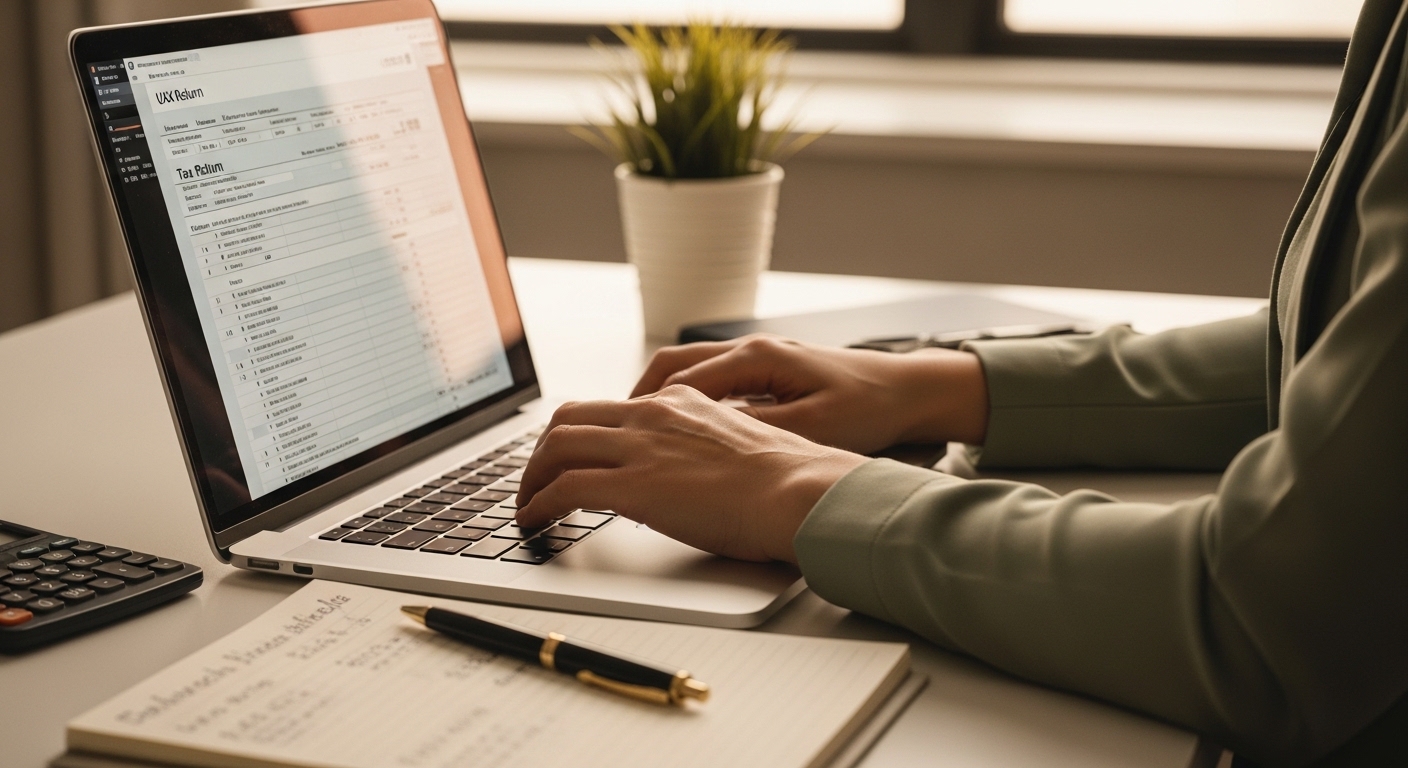
Tech spend is the most consistently under-claimed expense category for creative and digital freelancers. A typical illustrator, developer, designer, copywriter, or content producer spends well over £2,000 a year on laptops, monitors, software subscriptions, cloud storage, AI tools, and hosting, and large parts of that figure go unclaimed because the freelancer assumes "I would have bought it anyway" or is unsure how the capital-versus-revenue line works. The mechanics are not complicated: equipment is claimed through the Annual Investment Allowance, software and SaaS are revenue expenses claimed in the year they are incurred, and the only point that genuinely needs attention is the wholly-and-exclusively rule for items used partly for personal life.
This piece walks the capital-versus-revenue distinction for tech spend, the Annual Investment Allowance and how it puts laptops and other equipment fully into expense in the year of purchase, the treatment of software, SaaS subscriptions, AI tools and cloud services, and the apportionment rules for items used partly for personal use. It sits in the maximising allowable expenses hub alongside the sister piece on home office expenses and the flat rate versus actual cost choice.
Capital versus revenue for tech spend
Tax law divides business spending into two categories. Capital expenditure is spending on long-lasting assets that benefit the trade beyond the current year, traditionally claimed through capital allowances over time rather than as an immediate deduction. Revenue expenditure is the day-to-day running costs of the trade, deductible against profit in the year incurred. For a freelancer, laptops, desktops, monitors, cameras, and other equipment with a useful life of more than a year are capital; monthly software subscriptions, cloud storage, hosting, and consumables are revenue. The distinction matters less in practice than it used to because the Annual Investment Allowance largely collapses the capital side into an immediate deduction.
Get help with your tax
Fixed fees. Free 15-minute call. No obligation.
The Annual Investment Allowance
The Annual Investment Allowance (AIA) is the part of the capital allowances regime that lets a sole trader or limited company deduct 100 percent of qualifying capital expenditure on plant and machinery (including computer equipment and most tech hardware) against profits in the year of purchase, up to the AIA annual limit. The AIA limit was made permanent at £1,000,000 per year, which is materially higher than any plausible tech spend a freelancer will make. In practice, AIA means a laptop, desktop, monitor, camera, or workstation is fully deductible in the year it is bought, even though it is technically a capital item.
The freelancer does not need to apply for AIA separately; it is the default treatment claimed through the Self-Assessment capital allowances section. A £1,500 laptop bought in October 2025 produces a £1,500 deduction in the 2025-26 return, reducing taxable profit by the full amount in that year. The same calculation runs through the income tax computation and the Class 4 NI computation, so the full effective tax saving is the AIA deduction multiplied by the marginal income tax rate plus 6 percent Class 4 (where in the main band).
A worked tech-spend example
A freelance video editor with £55,000 of self-employment profit buys a £2,400 MacBook Pro, a £600 secondary monitor, and £450 of editing software upgrades in the year. The MacBook and monitor (£3,000) are equipment and fall under AIA; the software upgrades (£450) are revenue. Combined deduction is £3,450, cutting taxable profit from £55,000 to £51,550.
The marginal-rate effect on the saving
At the freelancer's marginal rates (40 percent income tax plus 2 percent Class 4 on the higher-rate slice), the saving on the top portion is around 42 percent of the deduction, with the rest saving 26 percent (20 percent income tax plus 6 percent Class 4 in the main band). The "I would have bought it anyway" reasoning misleads: the equipment cost is the same either way, but the tax-relieved cost is materially lower.
Software and SaaS as revenue expenses
Software bought outright (rare in modern freelancing) was traditionally capital but is increasingly treated as revenue where the freelancer pays for ongoing use rather than perpetual ownership. The much more common modern case is SaaS subscriptions, where the freelancer pays a monthly or annual fee for a cloud-delivered service: Adobe Creative Cloud, Microsoft 365, Figma, Notion, Slack, GitHub, Vercel, AWS, ChatGPT Plus, Claude Pro, Midjourney, Linear, FreeAgent, Xero, QuickBooks, Calendly, and so on. All such subscriptions are revenue expenses claimed in the year incurred. There is no capital allowance question and no useful-life apportionment.
- Adobe Creative Cloud and similar design-tool subscriptions.
- Microsoft 365 and Google Workspace.
- AI tools used for work (ChatGPT Plus, Claude Pro, Midjourney, Perplexity Pro).
- Project management and collaboration (Notion, Linear, Asana, Slack).
- Code repositories and cloud build platforms (GitHub, Vercel, Netlify).
- Cloud infrastructure and storage (AWS, Google Cloud, Cloudflare, Dropbox Business).
- Accounting and invoicing software (FreeAgent, Xero, QuickBooks).
- Backup, security, and password tools used for the business.
- Sector-specific tools (CRM, design libraries, font subscriptions, stock asset platforms).
The wholly and exclusively test for mixed-use tech
For an expense to be deductible, it must be incurred wholly and exclusively for the trade. The rule is strict in principle: an item with a personal-use element does not pass. In practice, HMRC accepts unavoidable de minimis personal use (the freelancer occasionally reads the BBC News on the business laptop), and a reasonable apportionment is usually accepted where business use dominates.
The defensive position is to apportion honestly. A freelancer with a single laptop used 80 percent for business and 20 percent for personal browsing claims 80 percent of the AIA-eligible cost. A freelancer with separate business and personal laptops claims 100 percent of the business laptop. A mobile line used wholly for business is fully deductible; a single mixed-use line is apportioned. The cleanest tax-efficiency move is to maintain clear device separation: a dedicated business laptop, a separate business phone number, and business email and storage subscriptions all behave as 100 percent deductible without apportionment.
AI tools, cloud and infrastructure
Subscriptions to AI tools used in producing client output (ChatGPT Plus, Claude Pro, Midjourney, Perplexity Pro, Notion AI) are deductible revenue expenses on the same basis as any other business SaaS. Cloud infrastructure used to deliver the freelancer's service (AWS, Google Cloud, Cloudflare, Vercel hosting, domain registrations, SSL certificates, third-party API costs) is also fully revenue. A freelance developer paying £150 a month for cloud services for client projects deducts the full £1,800 annually as an ordinary business expense. There is no capital allowance question, because the spending pays for current-period service rather than a long-lasting asset.
Repairs and upgrades to existing equipment
A repair to existing tech equipment (replacing a broken screen, a battery, or a power supply) is a revenue expense, deductible in the year incurred. An upgrade that significantly improves or extends the life of the asset (adding RAM, replacing a hard drive with a larger SSD, replacing a major component) is technically capital but in practice usually small enough to fall within the £1m AIA pool and be deducted in full in the year. The distinction matters where a freelancer is approaching the AIA limit, which is essentially never the case for a sole trader, so the practical effect is that almost all tech repair and upgrade spend is deducted in the year.
Equipment scrapped, sold, or stolen
When AIA-claimed equipment is later sold, given away, or scrapped, there is a balancing charge or balancing allowance reflecting the gap between the original deduction and the disposal value. A £1,500 laptop fully expensed and sold years later for £400 produces a £400 balancing charge in the year of sale. A laptop scrapped with no resale value produces nothing. The accounting runs through the same capital allowances section of the Self-Assessment return.
How VAT changes the picture for registered freelancers
A freelancer registered for VAT recovers input VAT on tech purchases and SaaS subscriptions where the supplier is UK VAT-registered or where the reverse charge applies for overseas suppliers (typical for US-based SaaS like Adobe or AWS). The recoverable VAT reduces the net cost, and the AIA or revenue deduction is claimed on the net figure rather than the gross. VAT mechanics sit in the VAT for freelancers hub; the headline is that VAT-registered freelancers should always recover input VAT before computing the income tax deduction.
Common tech-expense mistakes
- Failing to claim AIA on equipment in the year of purchase, assuming it spreads over a useful life.
- Claiming 100 percent of a single home laptop used materially for personal life.
- Forgetting to claim small but persistent SaaS subscriptions that add up to thousands annually.
- Treating cloud infrastructure as capital because it is "technology" when it is actually revenue.
- Missing the balancing charge on disposal of AIA-claimed equipment in a later year.
- Including the VAT element of business tech in the income tax deduction when registered for VAT and entitled to recover the input VAT.
Do I need receipts for every SaaS subscription?
Yes, in principle, although it is far easier than it used to be. Almost every SaaS provider issues an automatic email receipt, which can be archived in a dedicated business folder and exported at year-end. For HMRC enquiry purposes, the bank or card statement plus the supplier email is normally sufficient evidence; HMRC accepts digital records under Making Tax Digital.
Can I deduct equipment bought before I registered as self-employed?
Yes, in limited cases. Equipment owned at the date of starting self-employment can be brought into the trade at market value at that date, with capital allowances then available on that brought-in value. A £2,000 MacBook owned at start-up date and worth £1,200 then can be introduced at £1,200 and claimed under AIA or writing-down allowances. Pre-trading expenses rules also allow certain revenue costs incurred up to seven years before trading commenced (pre-launch software, research) to be treated as incurred on day one and deducted in the first year.
Where tech expenses sit in the wider deduction picture
Tech is one of the largest single deduction categories for digital and creative freelancers and one of the easiest to capture in full once the freelancer is organised about it. The sister piece on home office expenses and the flat rate versus actual cost choice covers the other major operating deduction. Together, home-office and tech often account for the bulk of the deductions that move the taxable profit figure, with travel, training, marketing, and capital allowances on larger equipment building on top.
Get help with your tax
Fixed fees. Free 15-minute call. No obligation.
About the author
FAH
Harrow Freelance Accountants
Articles on Harrow Freelance Accountants are written and maintained in-house by our editorial team. Harrow Freelance Accountants provides specialist accountancy for freelancers and contractors across Harrow and northwest London.